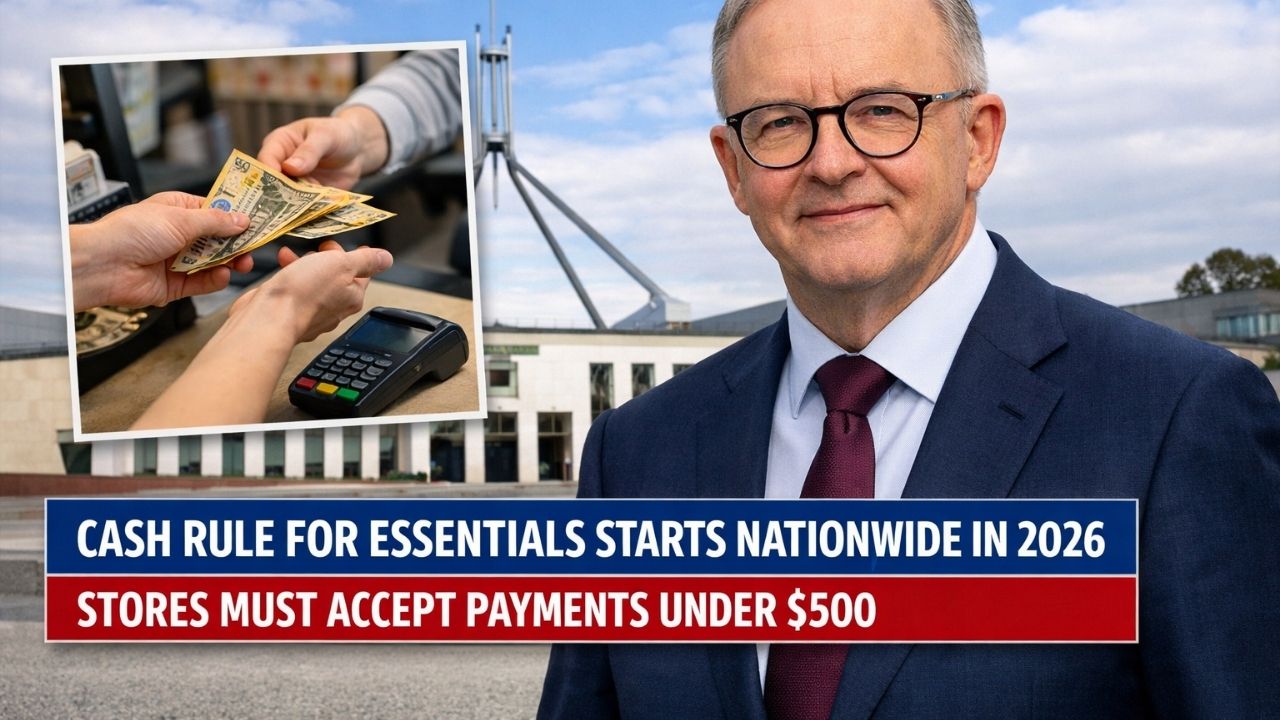
When Perth retiree Margaret Evans tried to pay cash for groceries earlier this year, she was told the store preferred card payments only.
“I don’t like tapping cards,” she said. “Cash feels safer to me.”
From 2026, that scenario may no longer occur in many essential retail settings. A new nationwide cash acceptance rule is coming into effect, requiring businesses selling essential goods and services to accept cash payments for transactions under $500.
The reform aims to protect consumer choice, safeguard vulnerable Australians, and maintain access to physical currency in an increasingly digital economy.
Here’s what the new rule means, who it applies to, and how it will affect shoppers and businesses across Australia.
Why the Cash Rule Is Being Introduced
Australia has seen a rapid decline in cash usage over the past decade, with many retailers shifting to card-only systems.

However, concerns have grown around:
- Digital exclusion of older Australians.
- System outages affecting EFTPOS networks.
- Privacy and data tracking concerns.
- Accessibility issues for low-income households.
- Resilience during emergencies and natural disasters.
A federal finance spokesperson said, “Cash remains legal tender. Australians should be able to use it for essential purchases.”
The rule seeks to balance digital innovation with consumer protections.

What the 2026 Cash Rule Requires
Under the new policy:
- Businesses providing essential goods and services must accept cash payments.
- The requirement applies to transactions under $500.
- It covers in-store purchases.
- It does not mandate businesses to provide change beyond practical limits.
- Online-only retailers are generally exempt.
The focus is on face-to-face retail transactions in essential sectors.
Which Businesses Are Covered?
While final sector definitions will be confirmed in implementation guidelines, essential businesses are expected to include:

- Supermarkets and grocery stores.
- Pharmacies.
- Fuel stations.
- Medical services.
- Public transport ticket offices.
- Utility payment counters.
Luxury retail and online-only businesses may not be subject to the same obligations.
Real Stories Behind the Reform
In regional Queensland, pensioner Alan Morris supports the rule.
“When the power went out last year, only cash worked,” he said.

Meanwhile, Sydney small-business owner Chloe Nguyen says the transition may require operational adjustments.
“We prefer card for speed,” she said. “But we’ll comply.”
The reform reflects tension between convenience and accessibility.

Comparison Table: Before vs After 2026 Cash Rule
| Area | Before Rule | After Rule (Under $500) |
|---|---|---|
| Essential Retail | Card-only allowed | Cash must be accepted |
| Online Retail | Card or digital only | Exempt from cash rule |
| High-Value Purchases | Business discretion | Rule applies only under $500 |
| Refusal of Cash | Permitted in many cases | Restricted in covered sectors |
The change restores mandatory acceptance of physical currency in essential contexts.
What About Businesses’ Concerns?
Some retailers argue that:
- Cash handling increases security risks.
- Cash management incurs banking fees.
- Card payments streamline accounting.
- Insurance costs may rise with cash storage.
However, policymakers maintain that consumer access outweighs operational inconvenience for essential services.

Business groups are working with regulators to clarify compliance timelines and penalties.
Will There Be Penalties for Refusing Cash?
While enforcement details are being finalised, potential consequences for non-compliance may include:
- Regulatory warnings.
- Fines.
- Consumer complaint investigations.
Authorities are expected to prioritise education before penalties during the initial rollout period.

Broader Economic Context
The cash rule emerges amid:
- Rapid digital payment adoption.
- Growing debate about financial privacy.
- Increased cyberattack risks.
- Recent payment network outages.
Economist Dr. Claire Donovan notes, “Cash provides redundancy. In times of system failure, it remains functional.”
The reform underscores the importance of maintaining multiple payment channels.
What Consumers Should Know
- Cash remains legal tender.
- Essential retailers must accept cash under $500.
- Exact change may not always be available.
- Larger transactions above $500 may have different rules.
- Online purchases are generally exempt.
- Consumer complaints may be lodged if cash is refused improperly.
Understanding the limits ensures smoother transactions.
Frequently Asked Questions
1. Does the rule apply to all stores?
No, primarily to essential goods and services.
2. What is the $500 limit?
The obligation applies to transactions under $500.
3. Can stores refuse large denomination notes?
Policies may allow reasonable limits.
4. Does this apply to online retailers?
No, online-only businesses are generally exempt.
5. Are restaurants included?
If classified as essential services, likely yes.
6. What about market stalls?
Rules may vary based on business classification.
7. Can stores charge extra for cash payments?
Surcharging rules depend on consumer law.
8. When does the rule begin?
In 2026, with implementation details confirmed by regulators.
9. Can I pay bills in cash?
At physical service counters, likely yes.
10. Does this affect card surcharges?
Card surcharge rules remain separate.
11. Are ATMs affected?
The rule relates to retail acceptance, not ATM availability.
12. Why $500 specifically?
To balance consumer access with anti-money laundering considerations.
13. What if a store claims it is cashless?
Essential retailers must comply under the new rule.
14. Will penalties apply immediately?
An education period is expected before strict enforcement.
15. Where can I report non-compliance?
Through consumer protection agencies once the rule is active.
The nationwide 2026 cash acceptance rule marks a significant shift in Australia’s retail landscape. While digital payments continue to dominate, the reform ensures that physical currency remains a viable option for essential purchases.
For older Australians, rural communities, and households concerned about digital reliability, the rule offers reassurance that cash still has a place in the modern economy.






Leave a Comment